Behavior Monitoring & Control
Overview
Understanding how the brain drives behavior requires recording and controlling neural activity with millisecond precision while animals perform well-defined tasks. We have developed an integrated behavior control and recording platform that synchronizes multiple modalities — fiber photometry, electrophysiology, and two-photon imaging — around a common timing reference: the animal’s own sniff cycle.
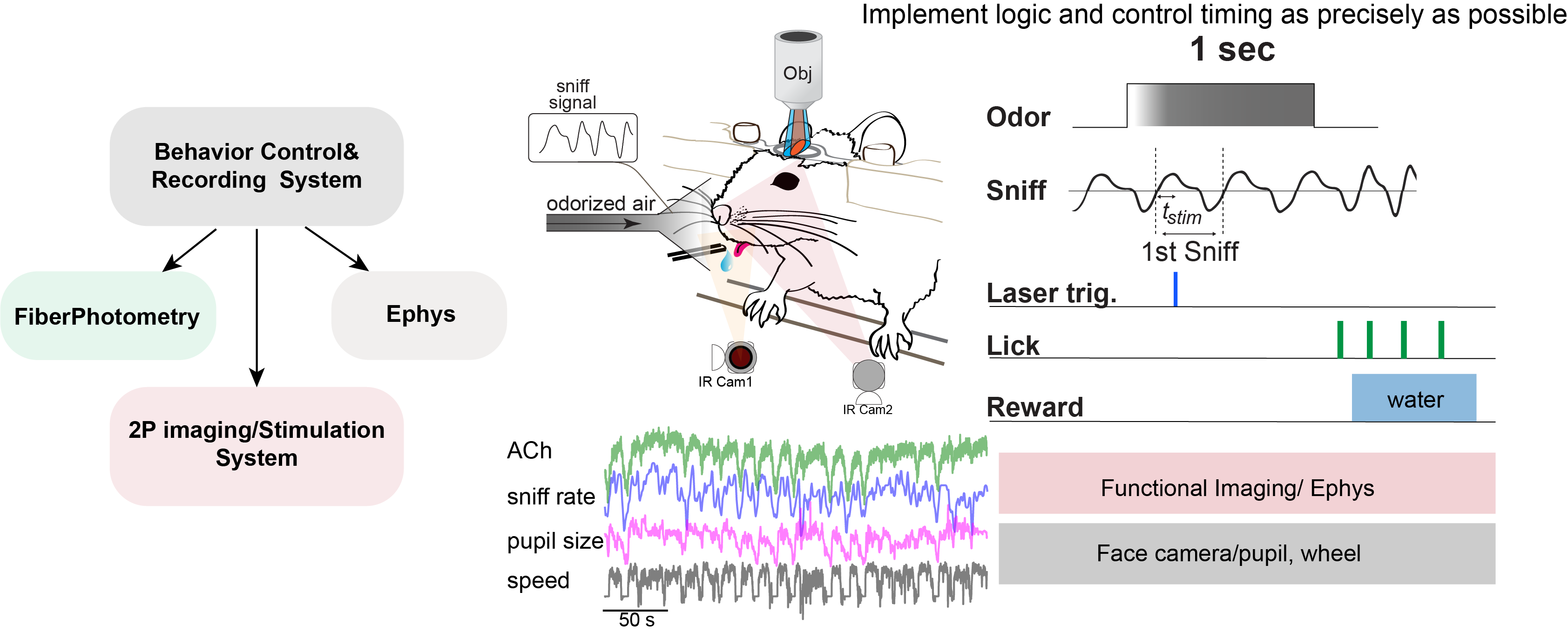
System Architecture
The platform is built around a central Behavior Control & Recording System that coordinates three recording modalities with sub-millisecond timing precision.
Fiber Photometry
Real-time readout of bulk neuromodulator signals (ACh, dopamine) and calcium activity from genetically defined cell populations during behavior.
Electrophysiology
Multi-site silicon probe recordings capturing single-unit and LFP activity across hippocampal and olfactory circuits simultaneously with behavior.
2P Imaging & Stimulation
Two-photon calcium imaging and optogenetic stimulation with targeted single-cell resolution, phase-locked to the sniff cycle.
Behavioral Paradigm
Animals are head-fixed and perform an odor-guided lick task:
| Event | Timing |
|---|---|
| Odor delivery | 1 sec pulse via olfactometer |
| Laser trigger | Sniff-locked — fires at first sniff after odor onset (\(t_{stim}\)) |
| Lick window | Monitored post-stimulus |
| Reward | Water delivery on correct lick |
Sniff phase-locking is critical — it aligns neural activity to a physiologically meaningful reference and enables comparison across trials and animals.
Continuous Monitoring Streams
Beyond the trial structure, we continuously record four parallel signals:
- ACh — cholinergic tone via fiber photometry (green)
- Sniff rate — breathing frequency from sniff sensor (blue)
- Pupil size — arousal proxy from IR face camera (magenta)
- Speed — locomotion from running wheel (gray)
This multivariate state vector allows us to disentangle neural activity driven by task events from that driven by fluctuations in arousal, movement, and neuromodulatory state — a critical confound in awake behaving recordings.
All modalities are synchronized to a common hardware clock. Stimulus delivery, laser triggering, lick detection, and camera frames are all timestamped to the same reference, enabling cross-modal alignment at single-sniff resolution.
Interested in collaborating or accessing our behavioral platform? Get in touch.