Neuromodulatory Oscillation Phase Gates Hippocampal Ripple–IED Competition
Overview
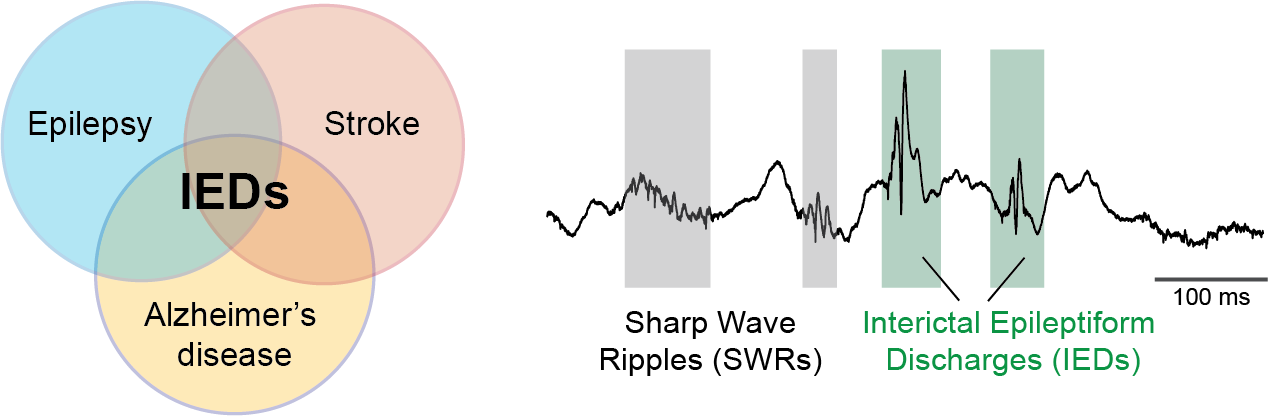
Interictal epileptiform discharges (IEDs) are a shared electrophysiological hallmark of epilepsy, stroke, and Alzheimer’s disease — and a direct antagonist of the hippocampal sharp-wave ripples that consolidate memory. We study how the dynamic oscillation of acetylcholine (ACh) across the sleep cycle gates the competition between these two event types, and how disrupting this neuromodulatory rhythm tips the balance from physiological memory consolidation toward pathological network synchrony. By targeting ACh oscillation phase rather than absolute cholinergic tone, we aim to develop intervention strategies that selectively suppress IEDs while preserving — and ultimately enhancing — the ripple activity that protects memory in aging-related brain disease.
System Architecture
The platform integrates three complementary modalities to monitor, decode, and intervene in hippocampal circuit dynamics across disease states.
Fiber Photometry
Real-time monitoring of neuromodulatory dynamics and calcium signals from genetically defined cell populations in freely moving animals.
Electrophysiology
Multi-site recordings capturing local field potentials and single-unit activity across hippocampal circuits with millisecond precision.
Closed-Loop Intervention
Real-time decoding of neural state to trigger precisely timed optogenetic or ultrasound stimulation, enabling causal testing and therapeutic application.
Behavioral Paradigm
Animals undergo a learning–disease–intervention pipeline combining hippocampus-dependent memory tasks with chronic disease monitoring:
| Phase | Paradigm |
|---|---|
| Memory encoding | Novel object recognition and contextual fear conditioning |
| Disease monitoring | Chronic LFP + ACh recording across sleep cycles in APP/PS1 mice |
| Intervention trigger | ACh trough duration threshold — fires when IED risk is detected (\(t_{stim}\)) |
Targeting the ACh oscillation phase rather than absolute cholinergic tone is critical — it aligns intervention to a physiologically meaningful reference and enables selective IED suppression without disrupting the ripple generation window.
Continuous Monitoring Streams
Beyond disease-state classification, we continuously record four parallel signals:
- ACh — cholinergic dynamics via GRAB-ACh3.0 fiber photometry, providing real-time oscillation phase for closed-loop triggering
- LFP — local field potentials from the DG–CA3–CA1 circuit, resolving sharp-wave ripples, IEDs, and their temporal relationship to ACh phase
- Behavioral state — locomotion speed and arousal markers to disambiguate sleep-stage boundaries and confine analysis to relevant epochs
- Intervention log — timestamped record of all optogenetic or fTUS pulses, enabling precise quantification of IED suppression and ripple preservation rates
This multivariate state vector allows us to assign each neural event — a ripple, an IED, an interneuron burst — to its exact position within the ACh oscillation cycle, turning correlative observations into a causally interpretable map of how cholinergic phase governs the boundary between memory consolidation and pathological discharge.
All modalities are referenced to a common hardware clock. ACh oscillation phase, LFP events, intervention pulses, and behavioral state markers are co-registered to the same timeline, enabling alignment of circuit dynamics and therapeutic responses at the resolution of individual oscillation cycles.
Interested in collaborating or accessing our behavioral platform? Get in touch.