Olfactory Object Processing
Overview
A central challenge in sensory neuroscience is understanding how the brain constructs stable percepts of objects despite enormous variability in the physical stimulus. For olfaction, the same odor can arrive at vastly different concentrations yet be immediately recognized as the same smell — a feat the brain accomplishes effortlessly.
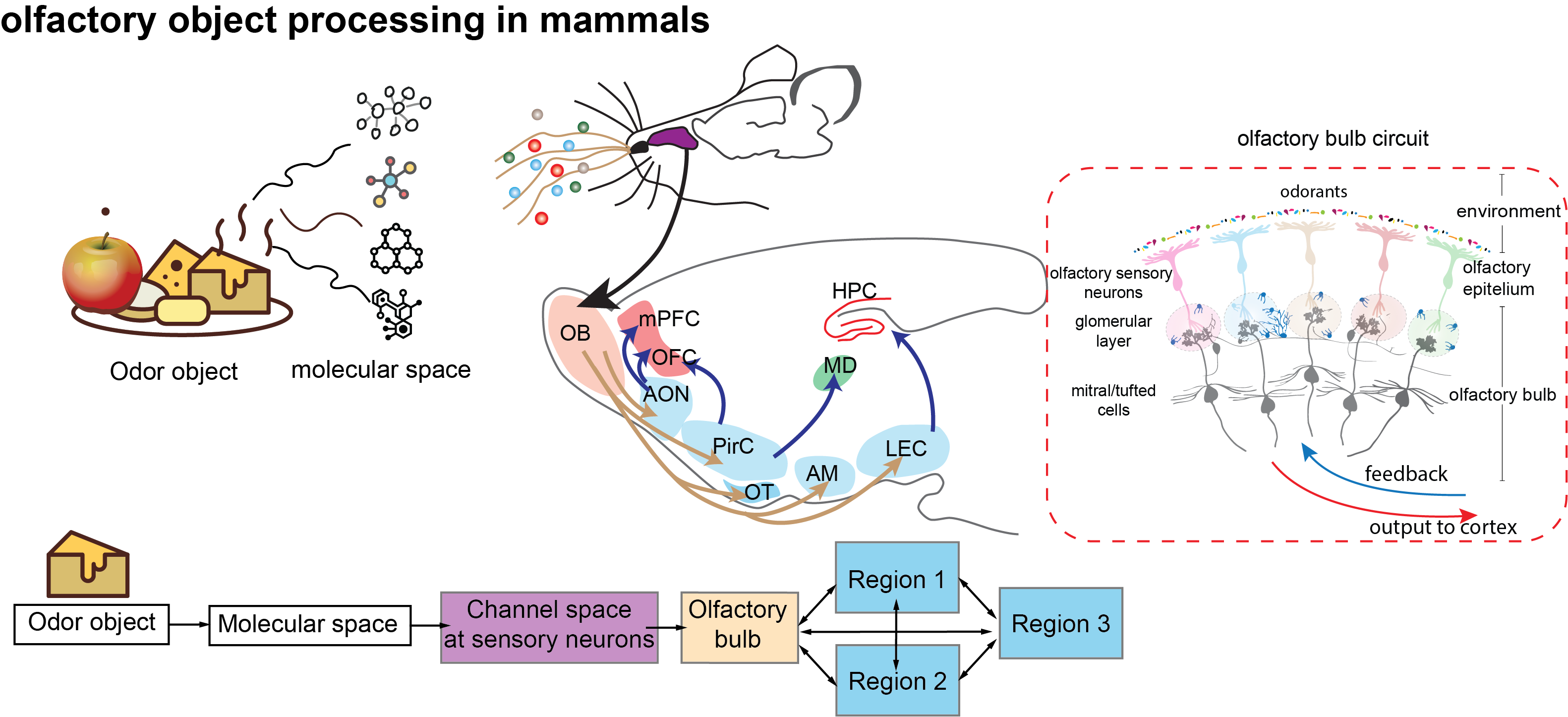
We study how the olfactory bulb (OB) solves this problem, acting as the first central relay where raw molecular signals from thousands of olfactory sensory neurons are transformed into representations that downstream cortical regions can use for recognition and decision-making.
Scientific Questions
- How does the OB network achieve concentration invariance in odor coding?
- What is the role of temporal sequence geometry in odor recognition and generalization?
- How do feedback projections from piriform cortex and mPFC modulate early olfactory processing?
- How does the OB interact with hippocampal and limbic circuits during odor-guided behavior?
Approach
We combine large-scale all-optical interrogation with electrophysiology to simultaneously read and write population activity across the olfactory bulb circuit during active odor sampling in head-fixed mice.
Recording
- Large-scale two-photon calcium imaging (GCaMP)
- Multi-site silicon probe electrophysiology
- Fiber photometry for bulk neuromodulator signals
Perturbation
- Targeted optogenetic stimulation (ChrimsonR, GtACR)
- Chemogenetic silencing of feedback pathways
- Closed-loop all-optical stimulus-response mapping
Key Findings
Team
This project is led by Mursel Karadas in collaboration with the Rinberg Lab and Shoham Lab at NYU.
Interested in collaborating? Get in touch.